Buying safely
Is my watch real gold?
A solid gold Omega lists for a median of $1,067 in our archive; a gold-plated one for $715. From across a room they look the same. Up close, the case back usually tells you which you have, in about the time it takes to read it.
A gold-coloured watch can be one of three things, and they’re worth very different amounts. We looked at 12,747 watches in our archive where the metal is known to show you how to tell them apart, what wear looks like on each, and what each is worth. The short answer on value:
- Solid gold is worth more, though less more than you might think.
- Gold-filled and gold-plated sell for about the same as each other.
- The watch itself, its maker and its condition, matters more than any of the three.
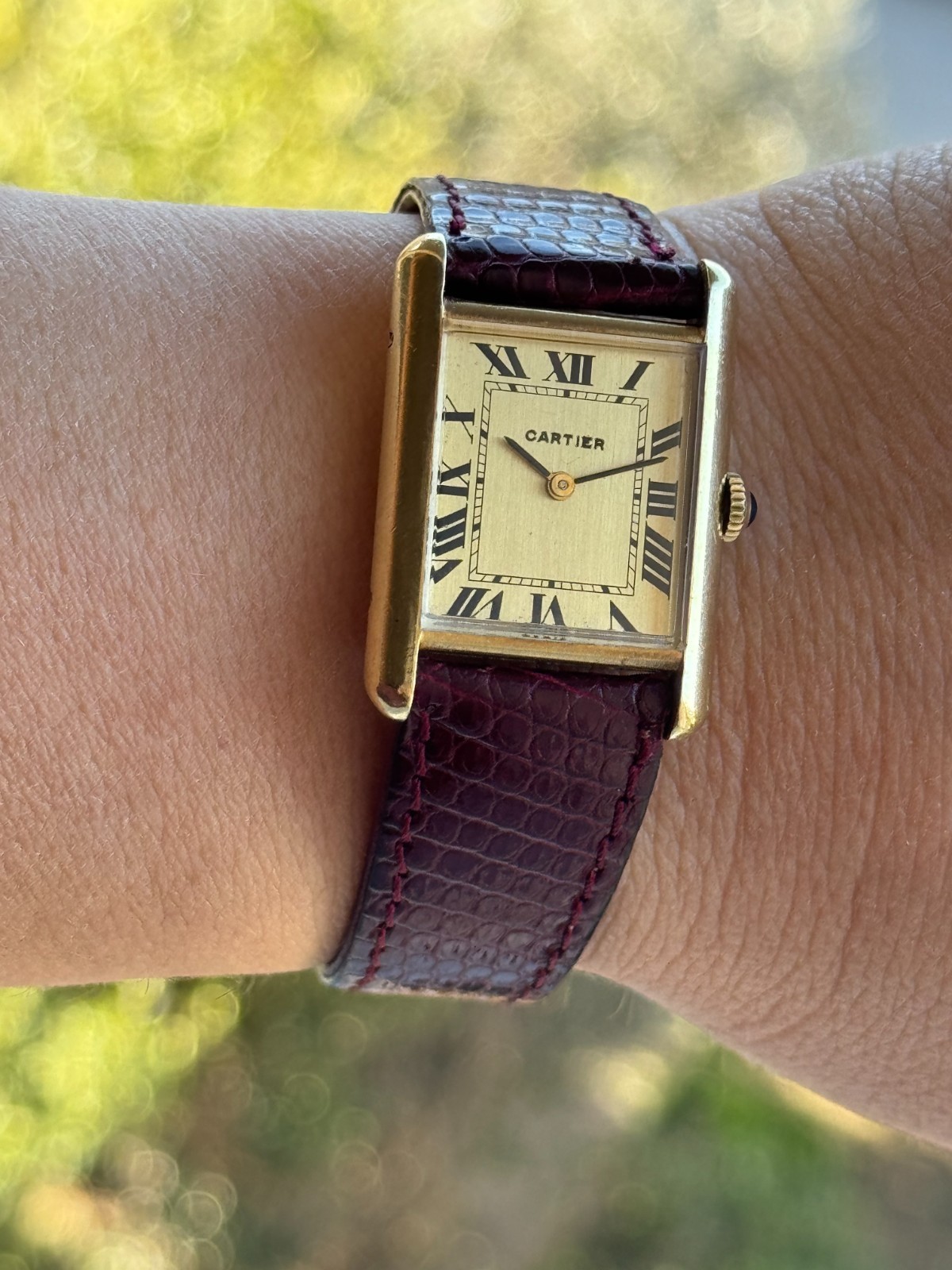
Three kinds of gold watch
From the front, all three are gold. What differs is how much gold there is, and that decides how it wears and what it’s stamped. If we had to pick one for daily wear on a budget, it would be gold-filled: it was built to last, and the market doesn’t charge extra for it.
| Kind | What it is | How it wears |
|---|---|---|
| Solid gold | Gold alloy all the way through. 18k, 14k or 9k. | Scratches, but almost never shows another metal underneath. |
| Gold-filled | A thick layer of gold alloy bonded to a base metal under heat and pressure. Rolled gold plate is the same method with a thinner layer. | Lasts decades; can eventually wear through on the sharpest edges. |
| Gold-plated | A thin layer of gold over brass or steel, measured in microns. | Wears through on edges, lugs and the back, showing the metal underneath. |
Is gold-plated real gold?
Technically, yes: there is real gold on the surface. But it’s a very thin layer over another metal, so for value it isn’t a gold watch at all. You’re buying the watch, and the gold is the colour.
Plenty of lovely watches were made gold-plated, and for our money a good plated Omega in fine condition is a smarter buy than a tired solid gold one from a lesser maker. The thing to avoid is paying solid gold money for plated. The gap is big enough that it’s worth five minutes to check.
How to tell: read the case back
On a watch, the most reliable clue is stamped into the metal, usually on the inside of the case back, sometimes on the outside. Here’s what each stamp means.
18K or 750 · 14K or 585 · 9K or 375
Solid gold, as long as the words “filled” or “plated” aren’t next to it. Older British watches often carry a hallmark too.
Gold Filled · G.F. · 1/20 12K
Gold-filled: a real, thick layer of gold over a base metal. Very common on American watches from makers likeElgin and Hamilton. The karat in the stamp describes the gold layer, not the whole case.
Rolled Gold · R.G.P. · 10K RGP Bezel
Rolled gold plate: made the same way as gold-filled, with a thinner layer. Often only the front is gold, with “stainless steel back” stamped behind.
Gold Plated · G.P. · 20 microns · Plaqué or
Plated. The micron number is the thickness of the gold layer, and more microns means it lasts longer.
925 · Sterling · Argent
Silver. On a gold-coloured watch it means gold over silver, which jewellers call vermeil. Must de Cartier watches are the famous example.
A plain steel back on a gold-coloured watch
Almost never solid gold. Makers fitted steel backs to plated and gold-filled cases to keep costs down; a solid gold case nearly always has a gold back to match.
No stamp at all, or only on the bracelet
Treat it as plated until someone who has opened the case says otherwise. A stamp on the bracelet clasp describes the bracelet, not the watch.
“Gold tone” or “gold colour” in a listing
It looks gold. That’s all it promises.
Here’s what those stamps look like on real watches for sale: a solid gold IWC, a gold-filled Elgin, and a plated Omega Genève with a steel back.


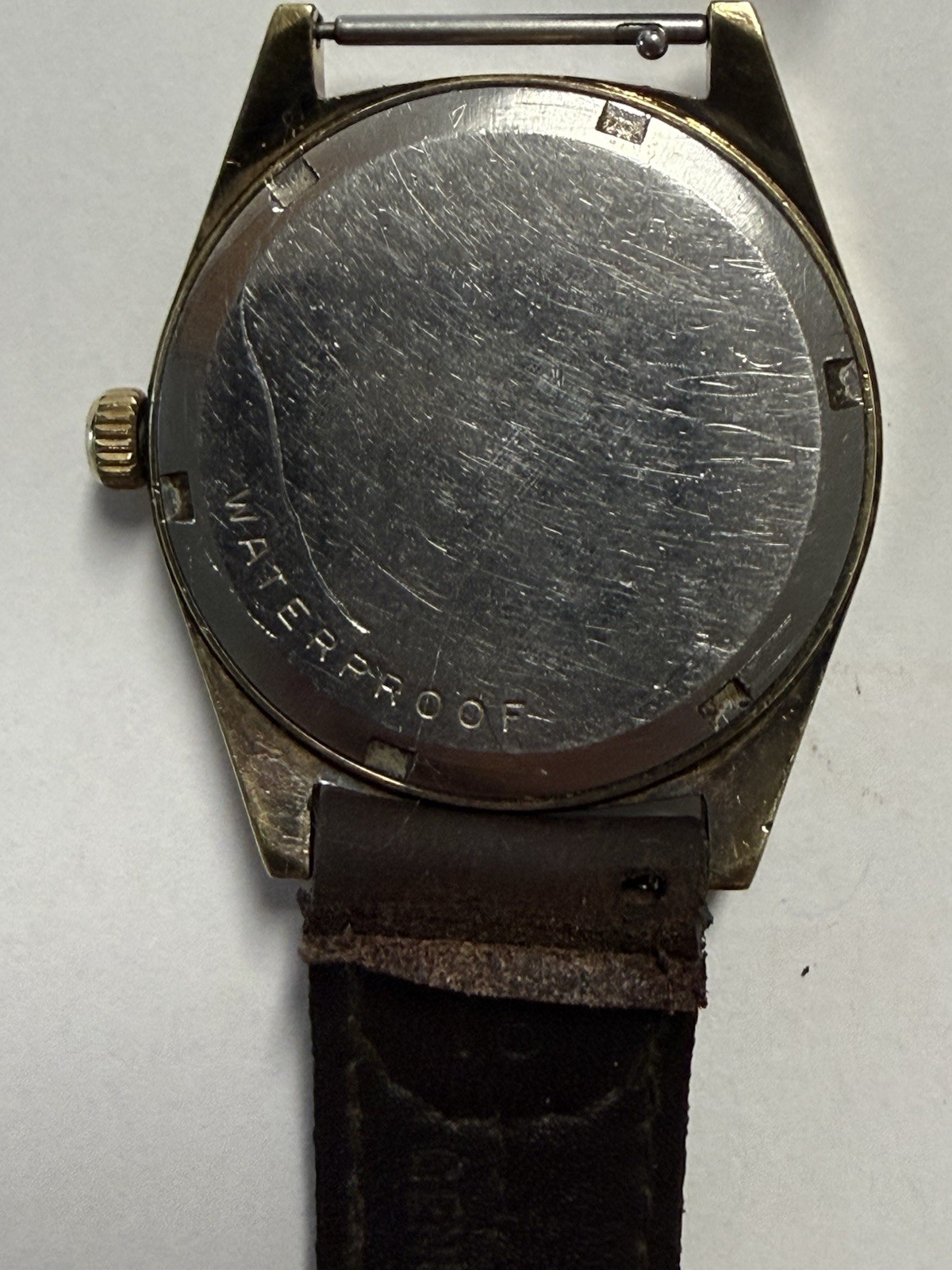
If the stamp is on the inside, don’t prise the back off yourself. Any watchmaker will open it in a couple of minutes, and it’s a shame to scratch a vintage case for the sake of a look.
Is 14k or 18k gold real gold?
Yes. Karats tell you how much of the metal is pure gold, and a karat stamp on its own means solid gold:
- 18k is 75% gold, stamped 750 (750 parts in a thousand). Most European gold watches.
- 14k is 58.5% gold, stamped 585. Most American gold watches.
- 9k is 37.5% gold, stamped 375. Common on British watches.
The rest is other metals, which make it harder wearing and set the colour: that’s where yellow, rose and white gold come from. Sellers lean on these numbers in their titles (599 titles in our archive mention 18k or 750), so check the title against a photo of the stamp before you trust it.
What wear looks like
Plating gives itself away with age. It wears first where the watch rubs against your wrist and sleeve:
- The tips of the lugs
- The sharp edges of the case
- The rim of the case back
Underneath you’ll see a different metal, usually a brassy yellow or a dull grey. The trade calls this brassing.
Here it is on a plated Omega De Ville, seen from the side.

Our photos bear this out. Of 84 gold-plated watches where the case was clearly shown, 18 had the base metal showing through. Of 91 solid gold watches, just one. Brassing also tells you the watch won’t look new again without replating, which on most vintage pieces costs more than it adds.
Can you test gold at home?
Search for this and you’ll find a dozen tricks: the magnet, the lighter, vinegar, toothpaste, a scratch on a tile. On jewellery some of them half work. On a watch, we’d leave every one of them alone.
The magnet test
Not harmless on a mechanical watch: a strong magnet can magnetise the hairspring inside and make the watch run fast. It also proves very little, because the brass under most plating isn’t magnetic either.
Lighter, vinegar, toothpaste and scratch tests
These can mark or discolour the case, and on a plated watch they can strip the very layer you’re trying to judge.
What to do instead
Read the stamp, or ask a watchmaker to open the case and read it for you. Some jewellers also have an X-ray tester that reads the metal without marking it, though it only sees the surface, so a thick gold-filled layer can fool it.
What it does to the price
Across watches listed today, solid gold has a median of $3,750 and plated $670. Most of that gap is the brands rather than the gold, because the big names made more solid gold. The same brand in each metal is a fairer comparison:
| Brand | Solid gold | Gold-filled | Gold-plated |
|---|---|---|---|
| Omega | $1,067 (654) | $899 (25) | $715 (403) |
| Longines | $760 (136) | $488 (24) | $463 (152) |
| Hamilton | $529 (77) | $395 (53) | $400 (117) |
| Bulova | $516 (38) | $350 (136) | |
| Elgin | $420 (27) | $335 (14) | $325 (97) |
| Cartier | $4,593 (331) | $1,782 (482) |
Median listing price across live and sold listings, number of watches in brackets. Listing prices, not sold prices. DialHunter archive, October 2026.
What the table tells you:
- On the American and mid-range Swiss brands, solid gold lists for between a quarter and two-thirds more than plated, not ten times more. A small vintage case holds only a few grams of gold.
- Gold-filled sits right alongside plated, despite being far better made. The market prices the name and the condition, not the construction.
- Cartier is the exception, at more than twice the price for solid gold.
That Cartier gap comes from the Must de Cartier: most plated Cartiers in our archive are Must vermeil, gold over sterling silver. Lovely watches, but not solid gold, whatever the colour suggests.
To see what each of these is listing for today, browse Omega, Longines, Hamilton, Bulova, Elgin and Cartier, or everything we hold in gold.
And if you’re holding one: please don’t sell a vintage watch for the weight of its gold. Scrap buyers pay for the metal and nothing else, and a working vintage watch is almost always worth more in one piece.
The short version
Solid gold.Stamped Gold Filled, G.F., Rolled Gold or RGP
A gold layer over base metal, thicker than plating.Stamped Gold Plated, G.P. or microns
A thin gold layer.Gold front, plain steel back
Almost certainly not solid gold.Another metal showing on the edges
Worn plating.For what else to look at on a vintage watch, see our guide to patina and dial damage.
Not sure about one you've found?
Send us the listing. We'll tell you what the case is likely to be, what that watch has actually sold for in our archive, and what to ask the seller before you pay.
Get a watch checked →Keep reading

